
In 2015, Texas Governor Greg Abbott signed Senate Bill 339, known as the Texas Compassionate Use Act, authorizing low-THC cannabis as a prescription treatment for intractable epilepsy. Four years later, House Bill 3703 expanded the act to include six primary conditions and other incurable neurodegenerative diseases.
The Texas legislature reconvenes in January 2021, creating an opportunity for lawmakers to address COVID-19 recovery, the opioid epidemic, and the state’s budget challenges. Expanding Texas’ Compassionate Use Program (CUP) could improve patient access while supporting the state’s economy.
The Texas Original Compassionate Cultivation team advocates for three major changes to the current Compassionate Use Program.
Remove Restrictions on Qualifying Conditions
Texas has one of the most restrictive medical cannabis programs in the country, covering only one patient per 10,000 people. Neighboring states such as Oklahoma, New Mexico, Arkansas, and Louisiana provide access to significantly more patients. Even conditions commonly approved for medical cannabis elsewhere, including cancer, fibromyalgia, arthritis, PTSD, insomnia, anxiety, and nausea, remain largely ineligible in Texas.
Supporters believe doctors—not policymakers—should determine whether medical cannabis is appropriate for their patients. Removing restrictions on qualifying conditions would allow physicians to prescribe medical marijuana for a broader range of symptoms and improve access for Texans who may benefit from treatment.
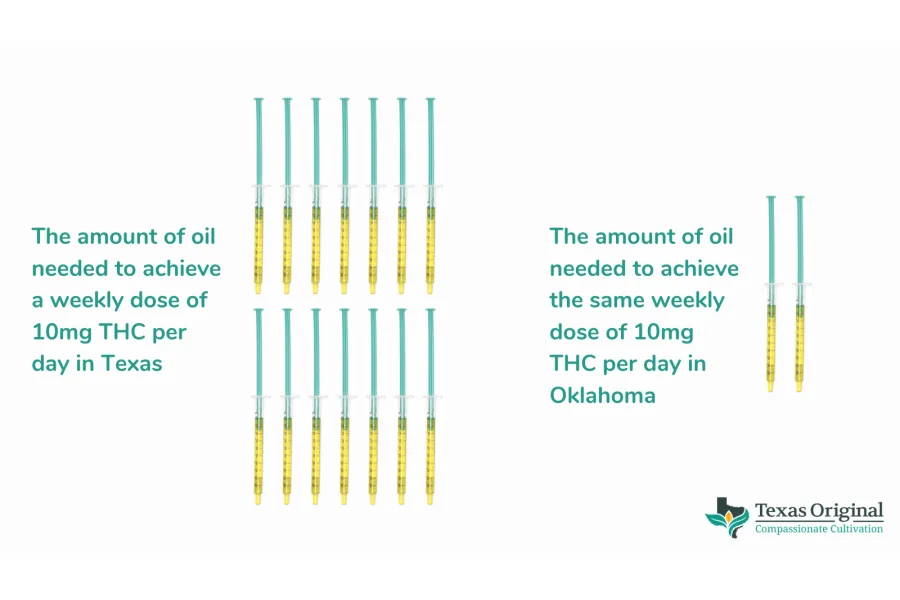
Texas patients must ingest seven times as much carrier oil to receive the same THC dose available to patients in Oklahoma because of Texas’ 0.5% THC cap on medical cannabis.
Eliminate the THC Cap
Texas law limits medical marijuana products to no more than 0.5% THC by weight. However, there is no limit on the total amount of THC a patient may consume. As a result, some patients must ingest large amounts of carrier oil to receive their prescribed dose, which may cause gastrointestinal discomfort.
THC can play an important role in helping patients manage chronic pain, insomnia, nausea, and muscle spasms. Without access to higher-THC medical cannabis, some patients and physicians may rely more heavily on opioid medications for pain management.
Texas is home to four of the top 17 U.S. cities for opioid abuse. Physicians write an average of 47.2 opioid prescriptions for every 100 people. According to CDC data, overdose deaths increased significantly during the COVID-19 pandemic.
Medical marijuana has also been studied as a possible alternative to opioids. A systematic review reported reductions of 64–75% in opioid dosage among patients using medical cannabis, while 32–59% of participants reported completely stopping opioid use for chronic non-cancer pain.
Advocates argue physicians should have the flexibility to prescribe THC, CBD, and other cannabinoids according to each patient’s needs without restrictive state-imposed dosage limits.
Enable Medical Marijuana Businesses to Operate Like Other Texas Businesses
The past several years have demonstrated that Texas can safely regulate a medical marijuana program through the Department of Public Safety. As patient demand grows, supporters believe licensed businesses should be allowed greater operational flexibility.
Allowing inventory to be stored in multiple retail locations would improve statewide patient access and better prepare businesses to serve future demand.
Expanding the Compassionate Use Program could also generate economic benefits for Texas through construction, real estate, delivery services, tax revenue, and job creation. Estimates suggest a broader medical marijuana industry could create more than 44,000 direct and indirect jobs, generate approximately $1.6 billion in state tax revenue, and contribute around $17 billion in total economic output during its first five years.
Want to Help Change Medical Marijuana Policy in Texas?
The legislative session provides an opportunity for Texans to advocate for changes to the state’s medical marijuana program. Here are a few ways to get involved:
- Subscribe to our email list for updates and advocacy opportunities.
- Contact your representative.
- If you’re a current patient, share your story here.
Think you may qualify for medical cannabis in Texas? Learn more about the current qualifying conditions below.